.png)
One River, Many Waters
- Robin Lunn

- 11 minutes ago
- 6 min read
On Sunday, August 30, we will gather at Camp Adams to celebrate the baptism of three and the rededication of one members of our Discipleship Class. They range in age from 16 to 80. Some come from long church backgrounds and others from almost none; some were raised in the faith, others are stepping into it for the first time. What they share is a decision to follow the Jesus Way, and their witness invites the rest of us to remember our own commitment, whenever and however it was made.
Last week our Discipleship Class met with the Salem Youth Collective during their summer camp, and together we learned three words for three ways water has long been used in baptism: aspersion (sprinkling), affusion (pouring), and immersion (going down into the water). Part of what we discovered is that the great river of Christianity has room for all three. Different streams within the church have welcomed believers into the Way by each of these means, and the church across time and place has recognized them all.

That has been true from very early on. The oldest set of baptismal instructions we have outside the New Testament comes from a short first-century manual called the Didache. It tells the church to baptize in "living water" — a flowing stream or river — but if running water isn't available, then in other water; and if there isn't enough for that, to pour water three times over the head. In other words, the earliest guide we have already assumed that circumstances would vary, and it made room for more than one way to baptize.
For the first centuries, immersion was the normal and preferred practice, and pouring or sprinkling was used primarily when someone was sick, imprisoned, or near death and could not be brought to a river or font. Over the following centuries the practice branched. In the Christian East, immersion remained the standard — Eastern Orthodox churches still immerse, even infants, to this day. In the West, pouring gradually became the common form, and by the later Middle Ages it had become the ordinary practice. By the time of the Reformation, sprinkling and pouring were widespread across many Protestant churches, while others returned to immersion as the biblical pattern.
So the range of ages and backgrounds in our own class is a small picture of something much larger. For two thousand years, people young and old, from every kind of beginning, have come to the same water by different paths and different means — and the church has kept saying yes.
If the church accepts sprinkling, pouring, and immersion alike, what keeps baptism recognizable from one tradition to the next? The answer is a simple, ancient core: water, and the name of the Triune God — "Father, Son, and Holy Spirit." That combination is why a baptism done in a Catholic parish, an Orthodox cathedral, a Methodist chapel, or a UCC sanctuary (or river) is generally honored by the others without being repeated. The World Council of Churches worked toward that mutual recognition for decades, and its 1982 Lima document, Baptism, Eucharist and Ministry, helped many churches affirm one another's baptisms on exactly this basis. The modes may differ; the water and the Name are the common thread.

Progressive Christians have wrestled with that inherited language. The words "Father" and "Son" carry deep scriptural and liturgical weight, but they are also gendered, and many of us want language that doesn't imply God is male. One response has been to expand the words — to name God not only as Father, Son, and Holy Spirit but also by what God does: Creator, Redeemer, Sustainer. On Sunday we will add our own expansive language, naming God as "Creator of us all."
It's worth being clear about what we're doing, because it bears on that thread of recognition. There's a difference between adding to the historic formula and replacing it. Some churches have swapped out "Father, Son, and Holy Spirit" entirely for "Creator, Redeemer, Sustainer," and Catholic, Orthodox, and some Protestant bodies do not accept those baptisms as valid — they read the substitution as naming what God does rather than who God is. By keeping the ancient words and adding to them, we hold both things at once: language that reaches wider, and a baptism the whole river still recognizes as baptism.
Underneath the modes and the words is a deeper question: what is baptism actually for? In our tradition, baptism is less something we achieve or something done for us. Rather, it is initiation. It is the moment a person is joined to the body of Christ and marked as belonging to God and to this community. The UCC Book of Worship calls it "an outward and visible sign of the grace of God," the "sign and seal" of a discipleship we then spend a lifetime growing into. It is also a covenant: the one baptized, the family, and the whole congregation promise to walk together in the Jesus Way.
Christians have long disagreed about how much the ritual itself accomplishes — its "efficacy." At one end, Catholic and Orthodox churches hold that the sacrament, validly performed, genuinely conveys grace in the act itself. At the other, many Baptist and evangelical churches treat baptism as an ordinance — an outward testimony to a faith already present, symbolizing but not conferring it. The UCC sits in the Reformed stream between these. We speak of baptism as a "sign and seal": the grace is real and it is God's gift, made visible and sealed by the Holy Spirit through the water — but the power belongs to God and the Spirit, not to the water itself, and it is received and lived out in faith over time. As a non-creedal church, the UCC holds this loosely and leaves room for a range of understanding. What we share is the conviction that the initiative is God's before it is ours.
On top of this there are three terms that get tangled, so it's worth untangling them. To be christened is simply to be baptized — "christening" is an older, popular name for the same sacrament, historically tied to the giving of a Christian name. There is no separate rite; a christening is a baptism.
Dedication is a different thing altogether. In traditions that baptize only those old enough to choose it for themselves — many Baptists and other believer's-baptism churches like the Disciples of Christ — infants are not baptized but dedicated: blessed and named before God, with parents and congregation pledging to raise them in the faith, and the baptism itself left for the child to claim later as their own decision. Some UCC congregations offer infant dedication alongside infant baptism so that families can choose. The difference is real: dedication blesses and commits; baptism is the sacrament of claiming the Way, a ritual of belonging.
And because baptism is that ritual of belonging to the great river of Christ, it happens once. The UCC recognizes every Trinitarian baptism — in any tradition, by any mode — as valid, so we do not rebaptize. But for someone baptized as an infant, who never chose those vows and now wants to claim them, the church offers not a second baptism but a reaffirmation: confirmation, or a renewal of baptismal vows, in which a person says their own yes to what was once promised on their behalf. Some people want a ritual of water to mark this reaffirmation. The words would be different even if the ritual looks the same.
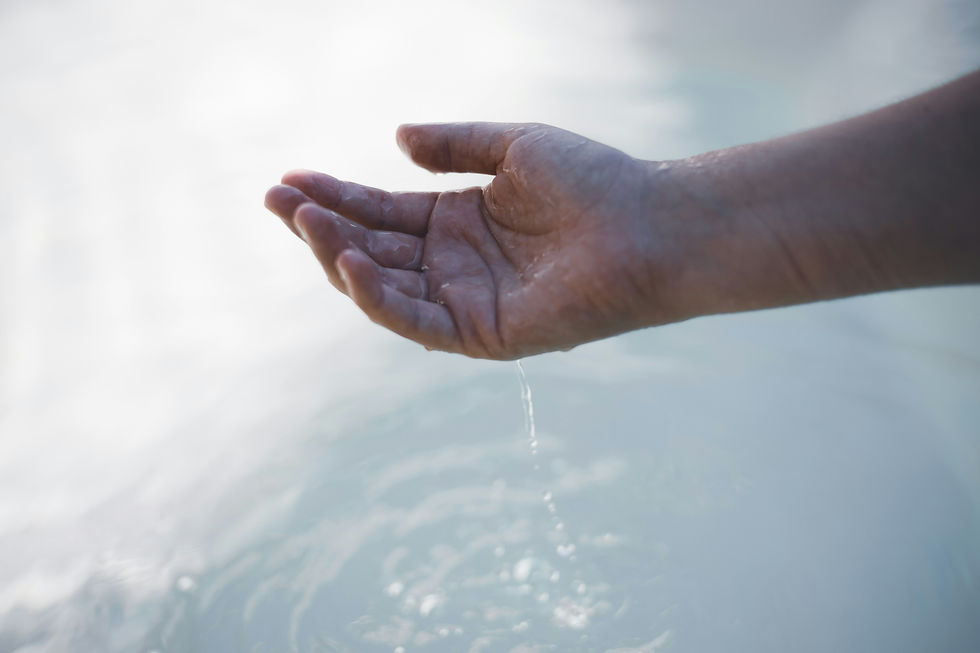
Which brings us back to the water. As of today, we don't yet know which method each person in this cohort will choose. Some may want to be immersed; some may ask for water poured over them; some may prefer to be sprinkled. That part is still unwritten. But the choice of method is not the heart of the matter. Whatever form the water takes, the commitment underneath it is the same: to follow Jesus, to belong to God's people, and to walk in the Way.
Come and witness. Come and remember. Come celebrate as the water is poured, or sprinkled, or as someone rises up out of it, and let the ritual call to mind your own baptism — the day you stepped into the same river the whole church has been in since the beginning.
In hopeful anticipation,
Pastor Robin


Comments